

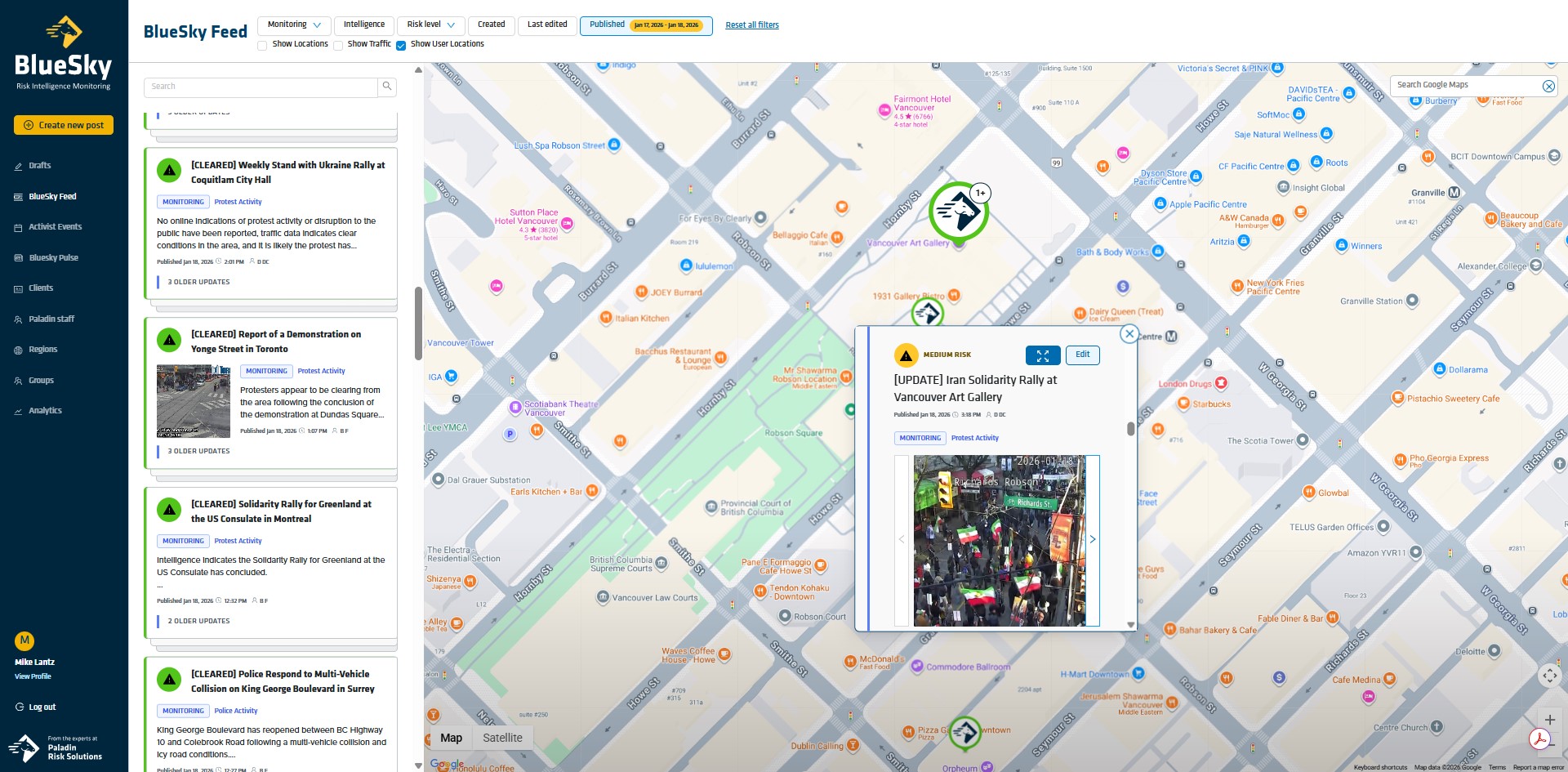


Protest and activism activity across Canada continues to increase, with the past weekend marking one of the more active periods seen in recent months. Large-scale demonstrations were recorded in most major urban centres, with Vancouver, Toronto and the Greater Toronto Area (GTA), Montréal, and Ottawa experiencing particularly high turnout. Several of these events resulted in significant transportation disruptions, impacts to surrounding businesses and infrastructure, and arrests in multiple jurisdictions.
This surge in activity is occurring against a backdrop of heightened global geopolitical tension. Ongoing U.S. military involvement and increasingly volatile international rhetoric are acting as catalysts for protest movements both globally and domestically. As a result, our intelligence monitoring indicates active planning and coordination for additional demonstrations throughout the coming week and into next weekend across multiple Canadian cities.
In addition to protests directly tied to international issues, we are also observing domestic groups leveraging the broader global environment to advance local or national agendas. Events such as the Stop Mass Immigration rally in Toronto highlight how international tensions can amplify or accelerate existing domestic movements. This convergence of global and local drivers adds complexity to the protest landscape and increases the likelihood of overlapping or competing demonstrations.
As protest volumes increase, so too does the risk of confrontation. We continue to assess an elevated likelihood of clashes between opposing groups, consistent with incidents observed over the past weekend and during previous protest cycles. These dynamics present heightened safety, reputational, and operational risks for organizations with assets, personnel, or operations located near protest activity.
From a national perspective, current analysis indicates a sustained 32% increase in protest activity compared to recent baselines, alongside a continued rise in early-stage planning and online coordination. Between January 19 and January 25, early confirmations and intelligence indicators point to the following anticipated protest activity in major Canadian cities: Vancouver (11), Calgary (3), Edmonton (2), Toronto and the GTA (9), Ottawa (5), and Montréal (1). These figures represent early-stage assessments only, and we expect the total number of events to increase as additional planning activity is identified.
Our BlueSky Risk Intelligence team continue to monitor global geopolitical indicators to assess how international developments may further influence protest activity within Canada. Historically, rapid shifts in global events often translate into near-immediate protest responses in major Canadian urban centres, particularly near government buildings, diplomatic sites, transportation hubs, and commercial districts.
At Paladin Risk Solutions, our objective is not only to report on protests as they occur, but to forecast them before they happen. Through BlueSky, clients receive early warning of emerging protest activity, insight into protest drivers and associated risk levels, and real-time intelligence as events develop. This allows organizations to plan proactively, adjust operations, protect people and assets, and reduce the impact of disruptions.
With recent enhancements to the BlueSky platform access to this level of intelligence is now more economical and scalable for organizations of all sizes. Combined with BlueSky Monitoring, which delivers live updates, movement tracking, and real-time situational awareness, clients gain a comprehensive view of evolving protest activity and associated risks across Canada.
As protest and activism activity continues to evolve in response to global and domestic pressures, timely intelligence and advance warning remain critical to maintaining operational resilience and informed decision-making.